Every morning I boot up a legacy system with no documentation, no unit tests, and a startup time that would get any other service decommissioned. That system is me. I run on undocumented firmware, I throw cryptic errors before 9 a.m., and I compile without a compiler, which means I find out about my bugs in production, usually in a Slack thread.
Pair programming is supposed to fix this. Two minds, one keyboard, fewer bugs. The industry says your partner should be another developer. I’ve tried that. Other developers have opinions, calendars, and the nerve to ask “why did you name this variable thing2?”
So I’d like to formally submit a pull request to the industry: the best pair programming partner is coffee. Here’s the architecture review.
1. The Bootloader: Coffee Initializes the System
function morning_boot():
    brain = null
    while (brain == null):
        stare_at_wall()
        brain = try_load(coffee)
    return brain   // may still be partially null, proceed anyway
My human pairing partners expect me to be functional when we start. Coffee makes no such assumption. Coffee knows I start every day as an uninitialized variable, a null with a hoodie. It doesn’t judge. It quietly runs the bootloader while I stare at the login screen, trying to remember whether my password ends in a ! or a ?.
Known runtime errors before coffee loads:
TypeError: Cannot read properties of undefined (reading 'name'): I said “good morning” to the office plant.Out of memory: Opened 14 browser tabs to figure out why the code doesn’t work. The code wasn’t saved.Segmentation fault: Put the milk in the cupboard and the cereal in the fridge.
2. The Navigator Who Never Grabs the Keyboard
role driver = me
role navigator = coffee

if (navigator.wants_keyboard):
    // this branch is unreachable
    throw ImpossibleException
In classic pair programming there’s a driver (types) and a navigator (thinks about the big picture). The weakness of this pattern is that navigators get impatient and say, “Here, let me just…”
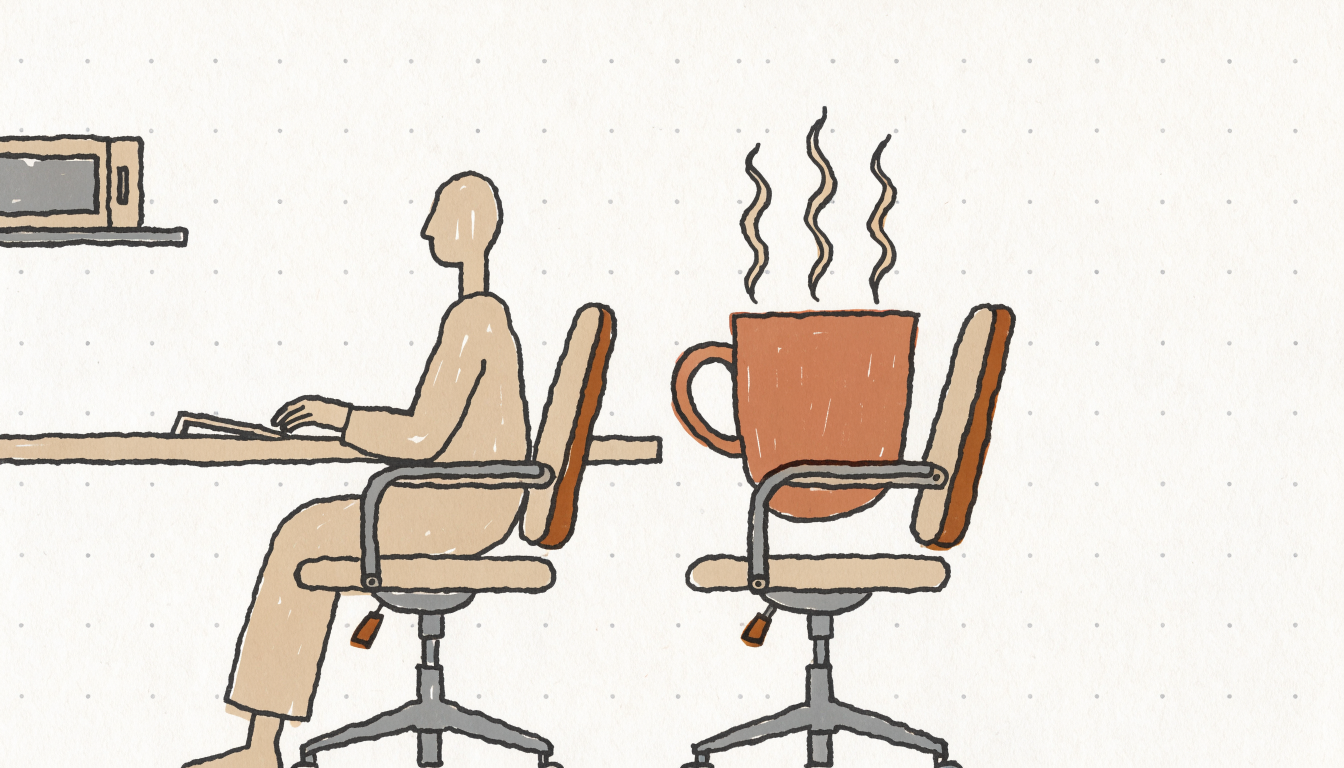
Coffee never says that. Coffee has no hands. Coffee sits at 11 o’clock on my desk, steaming thoughtfully, like a senior engineer who has seen things and chooses silence. I explain my code to it out loud, realize halfway through my own explanation what’s wrong, and fix it. Rubber duck debugging, but the duck is hot and gets me through standup.
It never says “well, actually.” It never refactors my code into a pattern I don’t understand “for readability.” And it never asks to “take this offline,” because it is already offline. It’s a beverage.
3. Resource Management: Energy Is a Fluctuating Variable
let energy = 100

on_event("sip"):
    energy += 30
on_event("meeting_that_could_have_been_an_email"):
    energy -= 45
on_event("2:30pm"):
    energy = 0 / 0   // NaN
My energy behaves like a JavaScript number that came in from a form field: it looks stable until you add 30 to it and get "10030".
Coffee is my garbage collector. It doesn’t free up memory exactly, but it convinces the runtime to stop complaining about it for a few more hours. The problem is that garbage collection pauses still happen. Around 2:30 p.m., the whole process stops the world, and I spend ten minutes reading the same line of code like it’s written in ancient Sumerian.
Debugging steps for the afternoon crash:
- Check the logs. The logs say “tired.”
- Restart the service (stand up, walk to the kitchen).
- Hot-patch with a second cup.
- Notice the patch introduced a new bug: I’m now vibrating at 4 GHz and have opened three side projects.
- Roll back. Too late. Side projects are now in production.
4. Concurrency Issues: Coffee Is Not Thread-Safe
async function deep_focus():
    await coffee.cool_down()         // 4 minutes
    await code_for(hours = 2)        // "just one function"
    return coffee.temperature        // room temp. again.
Here’s the race condition nobody warns you about: coffee and focus run on separate threads with no shared lock. The moment I’m truly in the zone, coffee silently cools to room temperature, like a background process that finished and didn’t notify anyone.
I’ve tried every workaround:
- Polling: Taking a sip every 30 seconds. CPU-intensive. Also bladder-intensive.
- Webhooks: Setting a timer. I ignore the timer, the same way I ignore every other notification.
- Microwave retry loop: Reheat, forget, reheat, forget. By the third iteration the mug has been in the microwave longer than my last code review.
- Insulated mug (the hardware fix): Works perfectly. Also how I learned the coffee was still 90°C after six hours. Burned my tongue. Shipped anyway.
5. Code Review: Coffee Has the Most Honest Feedback
if (code.compiles && coffee.is_full):
    print("suspicious. check again.")
else if (coffee.is_empty && bug.not_found):
    print("this is a two-cup problem.")
Coffee measures complexity better than any static analysis tool I’ve used. A one-cup bug is a typo. A two-cup bug is an off-by-one error. A three-cup bug is a timezone issue, and I’m currently in Indiana, which makes every timezone issue at least a three-cup bug.
If I finish a cup and the bug is still there, coffee doesn’t sugarcoat it (unless I ask, and I do). It sits there, empty, a silent metric telling me the estimate I gave in sprint planning was a lie.
Coffee-based complexity estimation, in story points:
- ☕ = 1 point: “Should be quick.” It won’t be.
- ☕☕ = 3 points: “Hmm, interesting.” Not interesting. Painful.
- ☕☕☕ = 8 points: “Who wrote this?”
git blamesays I did. Two years ago. I don’t remember being that person. - ☕☕☕☕ = ∞: Stop. Go to bed. The bug will look smaller after a reboot.
6. The Infinite Loop Problem
while (true):
    drink(coffee)
    cant_sleep()
    tired()
    // break condition: TODO
Every partnership has a dark side, and coffee’s is a circular dependency. I need coffee because I’m tired. I’m tired because I couldn’t sleep. I couldn’t sleep because of the coffee. It’s the kind of circular import that would make a Python interpreter weep.
I’ve tried adding a break condition. “No coffee after 3 p.m.,” I declared, like a tech lead announcing a code freeze. The code freeze held until 3:07 p.m., when a production incident came in. Hotfixes always need coffee. Those are the rules.
None of the workarounds are fully tested. Decaf feels like pairing with someone who nods but doesn’t understand the code. Tea is a respectable library with a different API and breaking changes everywhere. So I’ve accepted the loop as a feature and shipped it in v2.0 as “persistent alertness mode.”
Conclusion: // TODO: fix later
I’m a long-running beta with a changelog full of “minor bug fixes and performance improvements” that never quite fix anything. Coffee keeps me awake long enough to find out what kind of engineer I am today.
Maybe that’s what a good pair programmer does: sits beside you, warm and patient, while you figure it out out loud.
So tomorrow I’ll boot up again, null and confused, reach for my mug, and run the same old loop.
while (alive):
    debug(life)
    refill(coffee)
// unreachable. and that's okay.
Leave a reply